Stay Updated
 Follow us on Facebook
Sunfish
Warmouth Sunfish - Lepomis gulosus
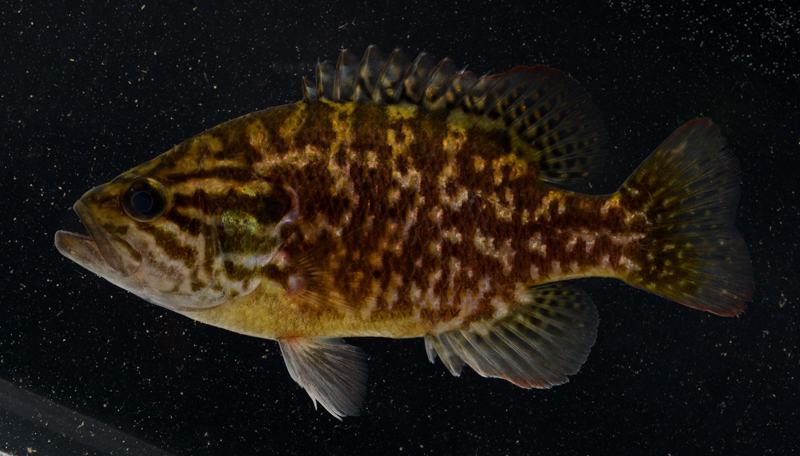
Male
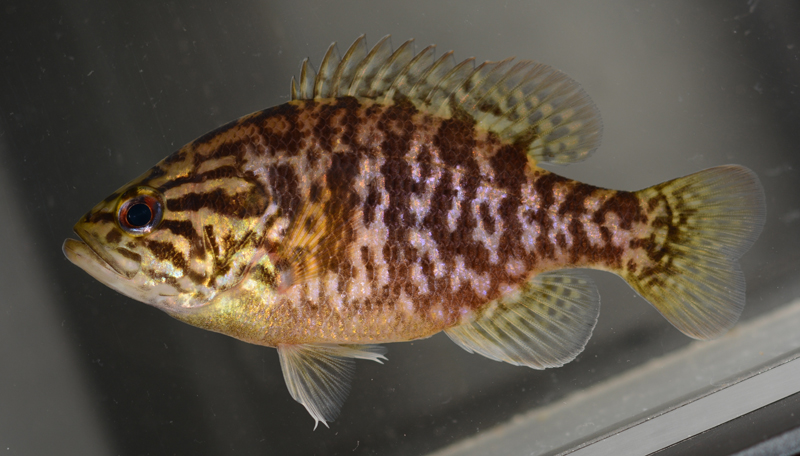
Female
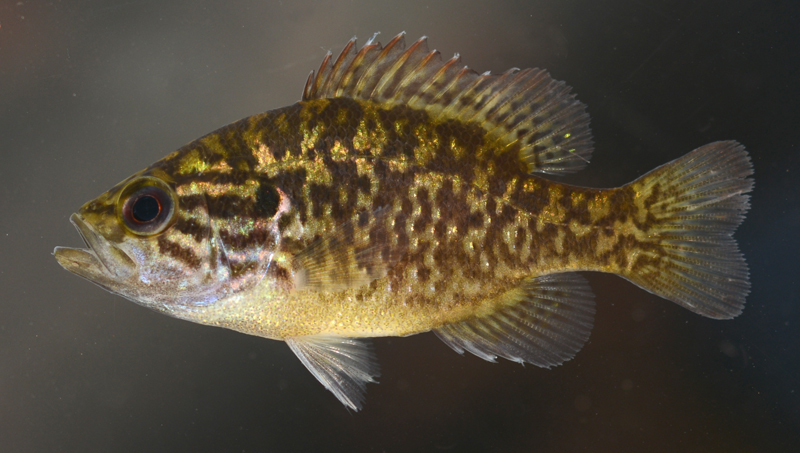
Juvenile
Captive Bred
Adult
Current Size: 3 - 4 inches
Max Size:
Males: 7 - 8 inches
Females: 5 - 7 inches
Occasionally well cared for male fish can reach 10 inches.
Price: $10.00 for 0.75 - 1 in fish
Price: $15.00 for 3 - 4 in fish
Origin: Warmouth are found throughout large parts of eastern North America in slower moving streams, wetlands, oxbows, and natural lakes. They prefer calm waters with lots of cover in the form of aquatic vegetation, logs, and brush piles. They are usually absent from fast moving rocky streams and rivers.
Coloration: They have a unique color pattern that can be highly variable and change quickly to blend in with their surroundings. They have a dark base color with specks of gold, orange, yellow or black. Fins can be outlined with a thin edge of white, orange or even red on some individuals. Males have a red/orange spot at the rear base of the soft dorsal fin.
Tank Size: They are great fish for larger aquariums or water gardens. They can also work as a single fish in a smaller tank. They are less territorial than most sunfish but have a big appetite with their oversized mouth allowing them to consume smaller tank mates, so choose similar sized fish. A single individual could be kept in a 20 gallon aquarium with good filtration. Consider a 55 gallon tank or larger for a group of 4 or more individuals. They enjoy a well decorated aquarium with lots of cover in the form of rocks, driftwood, or live plants.
Feeding: This is a naturally secretive fish in nature but adapt quickly in captivity to beg for food like other sunfish. They are not picky eaters and will take a wide variety of high protein pellets or frozen foods such as blood worms, mysis shrimp, or krill. This is a species that can be fed live feeder fish, but it is not required.
Water Conditions: Cold hardy so can winter over outdoors in a water garden. Can handle temp of 34-85 F. Spawn at 75-80 F. PH of 7-8.5.
Ozark Longear Sunfish - Lepomis megalotis
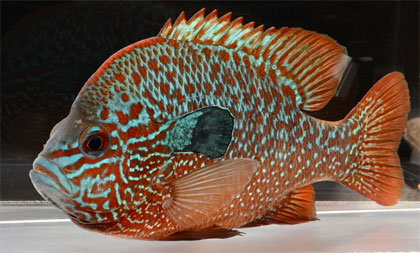
Male
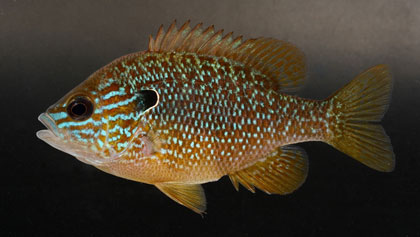
Female
Captive Bred
Adult
Current Size: 0.5 - 0.75
Max Size:
Males: 6.5 - 7.5 inches
Females: 4.5 - 5.5 inches
$10.00 ea
Origin: This particular strain of Longear Sunfish originates from the western part of the Ozarks in the Missouri and Arkansas River basins. They are most often found in clear rivers and streams. Longear Sunfish as a whole have a much larger distribution from the western slope of the Appalachian Mountains south westward to the northeast edge of Mexico.
Coloration: Ozark Longear Sunfish are in our opinion the most attractive looking sunfish, and our favorite fish! The colors of adult males rival any tropical, or marine fish with the most distinctive character of this strain being the red/orange stripe down the nape (middle of head/forehead area). Large males are covered in bright red/orange and blue speckling, particularly on the sides of the face where the colors form alternating lines. Even the females have nice coloration only a little less intense.
Tank Size: They are great fish for larger aquariums or water gardens. They can also work as a single fish in a smaller tank. They are territorial so if kept in groups we recommend 6 or more individuals in a 55 gallon or larger aquarium with good filtration. Making your aquarium more complex with lots of cover in the form of rocks, driftwood, or durable live plants helps break up lines of sight for separate territories for each individual fish in the tank.
Feeding: Like most sunfish they are very personable and quickly learn to beg for food. They are not picky eaters and will take a wide variety of high protein pellets, or frozen foods such as blood worms, mysis shrimp, or krill.
Water Conditions: Cold hardy so can winter over outdoors in a water garden. Can handle temp of 34-85 F. Spawn at 75-80 F. PH of 7-8.5.
Bantam Sunfish - Lepomis symmetricus

Male

Female
Captive Bred
Current Stock
Current Size: 0.75 - 1.25 inches
Max Size: Males 4 - 5 in. Females 3 - 4 in
Price: $10.00
Origin: Bantam Sunfish are found primarily in the flood plane lowlands of the Mississippi River basin from the southern tip of IN and IL and south from there across western KY, TN, southeastern MO, eastern OK much of AR, eastern TX, western MS and throughout much of LA. They are often found in cypress swamps, oxbows, and other similar habitats. They prefer calm waters with dense cover and vegetation.
Coloration: Bantam Sunfish are the second smallest of the Lepomis species of sunfish. They are covered in gold to light blue/green reflective spots and often have scattered black specs on the lower sides all on a dark green-brown background. Males get some red in the soft dorsal and tail fins. The juveniles have a black spot surrounded by a red halo in the soft dorsal fin that is retained in adult females but not in males. They have red eyes that become more intense in breeding males.
Tank Size: Less aggressive than some of the larger Lepomis species and a group of 6 could be kept in as small as a 30 gallon tank. They can also work as a single fish in 10 gallon tank. Most sunfish we recommend keeping in groups of 6 or more to help break down territorial aggression, these can be kept in smaller groups of 3 or 4. They can be territorial, particularly breeding males but defend a smaller area than most sunfish species. They do well in a well decorated aquarium with lots of cover in the form of plants, driftwood, or rocks to provide plenty of hiding places.
Feeding: Like most sunfish they are very personable and quickly learn to beg for food. They are not picky eaters and will take a wide variety of high protein pellets, or frozen foods such as blood worms, mysis shrimp, or krill.
Water Conditions: Cold hardy so can winter over outdoors in a water garden. Can handle temp of 34-85 F. Spawn at 75-80 F. PH of 7-8.5.
Bluespotted Sunfish - Enneacanthus gloriosus

Male

Female
Captive Bred
Adult
Current Size: 0.5 - 0.75 inches
Max Size: 3 - 4 inches
Price: $10.00
Origin: Bluespotted Sunfish are native to the Atlantic coastal plain from NJ south to and throughout FL and west along the Gulf Coast to the southern tip of MS. They are found in ponds, swamps, and sluggish streams. They are rather reclusive fish that live and hide in dense aquatic vegetation.
Coloration: Uniform body with scattered reflective light blue spots over their entire body. Fins of young have some rusty red color to them. Breeding males can be very dark over all which really makes the blue spots stand out.
Tank Size: Bluespotted Sunfish are small peaceful sunfish that can be kept in a much smaller setting than any of the Lepomis species. They are a rather secretive species and do best in a well planted aquarium. Large wild caught adults often do not adjust well to captivity and spend most of their time hiding. Starting with younger fish allows them to grow up and be more active and comfortable in a captive setting. A group of 4 or 5 can be kept in just a 10 gallon aquarium. These also work well in a larger community tank with other peaceful fish.
Feeding: Less aggressive at feeding and a little more picky than their larger Lepomis cousins. They do well on a varied diet of frozen foods such as blood worms or mysis shrimp. They will also gladly take live foods such as white worms or black worms. Some do take to small pellet foods over time.
Water Conditions: Cold hardy so can winter over outdoors in a water garden. Can handle temp of 34-85 F. Spawn at 75-80 F. PH of 6-8.
Livebearers
Melanistic Eastern Mosquitofish - Gambusia holbrooki
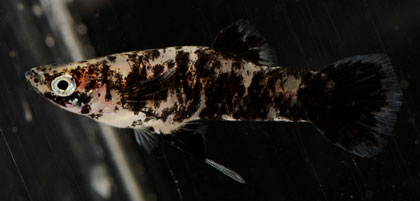
Male
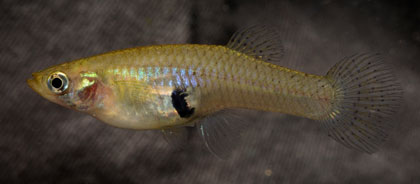
Female
Captive Bred
Adult
Max Size:
Males: 1.25 inches
Females: 2.5 inches
Price: $6.00 ea
or $10 for sexed pair
Origin: Found on the coastal plain from the Carolinas, throughout Florida and along the Gulf Coast west to southern Alabama and Mississippi. I originally caught my stock in Florida and have been line breeding these since 2018. I have added a few additional wild caught melanistic males to my breeding group since the original capture. At this point the majority of the males produced in this line are melanistic, probably better than 95% of the males produced. I continue to remove any normal gray males produced from my population. In 2023 I found the first melanistic female! This is incredibly rare I have never seen one in the wild! I have continued to find a few produced each summer. In 2025 I had a group of 6 and used only them to produce all the young I am currently selling. So all that are purchased from fall 2025 and into the future should be carrying the potential to produce melanistic females. Sorry, not enough melanistic females produced yet to sell any.
Coloration: These are normally a small gray fish with a few tiny black spots on the fins. The melanistic trait appears in the wild population on a small percentage of males giving them the dalmatian look of random black blotches and spots over a white or even translucent background. Females are a plain gray with the black spots in rows on the fins.
Tank Size: They don't need a lot of space even a 10 gallon tank is suitable for a small group. They do eat their fry so they are not a great livebearer for colony breeding. I like to use a layer of the floating plant hornwort, also known as coontail (this can be rooted but does fine just floating on the surface), and check the tank for fry hiding among this daily. This helps a lot with getting some young to survive. Bigger the tank and more hiding places the less of a need to remove the fry there is, you will get some survival with a dense layer of plants in a bigger (40 breeder or so) tank. I like to use smaller tank (20 long in winter) and then just remove the young when I find them.
Feeding: Not picky will feed well on flake food. I also feed mine some frozen brine shrimp and blood worms but this may not be necessary.
Water Conditions: Not Cold hardy in northern states like their close relative the Western Mosquitofish Gambusia affinis but can be kept outdoors in the southern US. Probably handles temps down in the 40’s just can’t handle ice. Do well outdoors in water garden ponds or even a tub on a porch in summer further north. Do not need to be heated indoors but I have found they produce more young in a heated aquarium kept at 75-80 F. PH of 6.5-8.5.
All Others
Southern Brown Bullhead - Ameiurus nebulosus

Adult

Juvenile
Captive Bred
Adult
Current Size: 1 - 1.5 inches
Max Size: 8 - 12 inches, occasionally larger in outdoor pnds
Price: $10.00
Origin:Brown Bullheads are native to most of eastern North America. They prefer lakes, ponds, and sluggish streams with aquatic vegetation. Not usually found in rocky flowing streams.
Coloration: They can be quite variable across their range, some populations have very little markings and are a solid dark brown color. Other populations have extensive marbling of black silver or brown markings.
Tank Size: Because of their large size these are best kept in a 40 gallon or larger tank. They are less territorial than some bullhead species and rarely show aggression towards one another. They also tend to leave other tank mates alone unless there is a drastic size difference. They can eat smaller fish if they are significantly smaller. They work well as tank mates for Lepomis sunfish species. They are also great water garden fish and are much more active in day light than many catfish species, our big adults actually come up and take pellets right out of our hands in bright sunlight. When spawning both parents will guard the swarm of young for a about a month, they are much more aggressive at this time.
Feeding: Easy to care for and will feed on nearly any kind of high protein pellet. Will also gladly take any kind of frozen food as well. They are not picky and will feed on just about anything you want to feed them, but rarely chase down live fish.
Water Conditions: Cold hardy so can winter over outdoors in a water garden. Do well in warm conditions. Can handle temp of 34-90 F. Spawn in summer at 78-85 F. PH of 7-8.5.
Shipping & Handling
- Customers are responsible for making sure they understand their local laws and have the proper permits that apply to their particular situation regarding the legality of purchasing, importing, or owning any of our fish in their state.
- We ship to US customers only. We use USPS Priority Mail to ship our fish.
- They should arrive in 2-3 days. We ship out on Monday & Tuesday to ensure a safe and live arrival.
- We also offer Express Mail by request.
- Prices depend on how many fish you are ordering.
- Priority Shipping starts at $15.00. We would be more than happy to give you a quote.
Payment
- We accept Personal Checks, Money Orders, or Paypal.
- Sorry no credit card or debit card payments at this time. Make your check/ Money orders to: Zimmermans Fish
- Once we receive your payment, your fish will go out on the following Monday or Tuesday.
- You will receive an email, so that you will know when to expect your fish.
- We package our fish by double bagging them in thick 3mil plastic bags, fresh clean water, and oxygen. They are then placed in an insulated box for shipment.
Brian and Julie Zimmerman
Phone: 330 417 9476 Email: smbass444@yahoo.com